


Height Sells: Using Risers and Tiers in a Fresh Food Counter
Height transforms a counter from flat to considered. That is how Dalebrook opens its 2026 riser range, and it is the shortest summary of why the best fresh food counters are never flat. Tiering dishes improves visibility, guides the eye and, in Dalebrook's words, increases perceived value and perceived abundance. A riser costs a fraction of a refit, yet it changes how every product above it is seen. This guide covers the five riser families — universal and twist risers, step risers, melamine slate-effect risers, HPL three-tier risers and stackable crate risers — with exact heights and footprints, plus a real butcher's counter built with them.
Why height sells
Three mechanisms do the work, all drawn from Dalebrook's own display guidance:
- Sightlines. Tiering dishes improves visibility: product at the back sits higher, so nothing hides behind the front row. Gloss and textured finishes reflect light and create a defined focal point.
- Perceived abundance. Layered layouts "guide flow and increase perceived abundance" — a stepped display reads as fuller and more generous than the same stock laid flat.
- Flow. Tiered dishes encourage movement through the display; risers let operators shape flow and guide the eye across the whole counter.
Crucially, purpose-built risers add dimension without clutter — they are made for food-safe environments and sized to the same footprints as the display trays and platters that sit on top of them.
The five riser types — and when to use each
1. Universal and twist risers: spot height under a single bowl
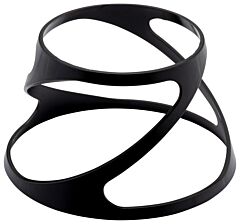
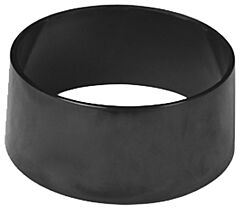
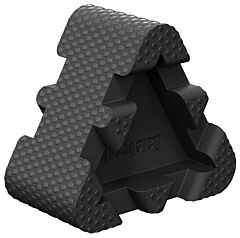
The quickest wins. The melamine universal riser (TB117, 109 x 109 x 50 mm) lifts one crock or bowl out of the flat line. Polycarbonate twist risers (170 mm diameter) come in 50, 100 and 150 mm heights in black or clear — clear versions make the product appear to float. Add pedestal stands (plain 70 mm, embossed 100 mm) for hero items, a non-slip slanted riser (90 x 90 x 30 mm) to tilt a dish towards the customer, and Peak (TB4125, 41 x 44 x 25 mm, packs of 12): a dishwasher-safe, non-slip thermoplastic block that lies flat, stands upright or interlocks. Use four under a platter or one under a bowl.
2. Step risers: full-width terraces with 45 mm treads
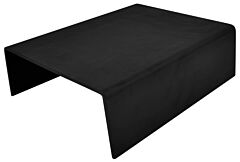
For a whole counter section, ABS step risers (795 x 300 x 90 mm and 795 x 600 x 90 mm) build even terraces where each step is 45 mm high — enough to clear the dish in front. The adjustable acrylic version (900 x 500 x 90 mm) extends from 600 to 900 mm deep with a non-slip surface, so one unit fits several counter depths. Smaller acrylic blocks are cut to Gastronorm fractions: 265 x 162 mm for 1/4 GN (50 or 100 mm high), 300 x 160 mm for 1/3 GN, and clear textured 305 x 250 mm risers for 1/2 GN in 40, 75 and 125 mm heights.
3. Melamine slate-effect risers: stone looks without stone weight
Slate-effect melamine risers (325 x 265 mm — a 1/2 GN footprint — in 50 and 100 mm heights) deliver the depth of slate without the weight of real stone. Non-slip silicone feet hold them steady during busy service, and the same profile comes in gloss black (300 x 250 mm). Because they match the GN footprint, the platter above always lines up with the riser below.
4. HPL three-tier risers: built for the chilled counter
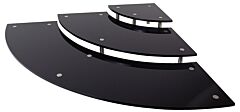
The HPL three-tier risers are the engineered option for demanding serve-over counters. High-Pressure Laminate withstands moisture and heavy use, and the open structure allows airflow beneath chilled units — height without blocking the cold air that keeps food fresh during service. Each three-step set rises in treads of 15, 57 and 100 mm and is manufactured to both professional footprints: 840-system sets in 210, 280, 420 and 630 mm widths, GN sets at 795 x 325 and 795 x 650 mm, plus corner (840 x 840 mm) and squircle sets. Five finishes — Carrara Marble, Bellato Grey, Kito Bronze, Oak and Slate — and custom sizes are available for non-standard counters.
5. Crate risers: stackable height with storage built in
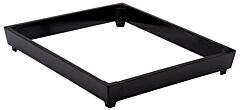
Tura and black frame crates (338 x 278 x 47 mm, sized to fit 1/2 GN) stack to build height, then take a 1/2 GN platter or dish on top to vary capacity. One crate gives a bakery-style lift; two or three build a stepped back row. Optional lids, such as the clear polycarbonate raised cover, add practicality for prep and storage — the riser doubles as a crate off the counter. If you want the same double duty in a crock, the Kata range is a reversible 3-in-1: crock, tray and riser in 40, 70 and 100 mm heights.
| Type | Heights | Fits | Best for |
|---|---|---|---|
| Universal, twist, Peak | 25–150 mm | Single bowl or platter | Spot elevation, hero products |
| Step risers (ABS/acrylic) | 45 mm per step, up to 90 mm | Full width or GN fractions | Terracing a whole section |
| Melamine slate-effect | 50 / 100 mm | 1/2 GN footprint | Stone look, busy service |
| HPL three-tier | 15 / 57 / 100 mm steps | 840 and GN | Chilled counters, airflow |
| Crate risers | 47 mm each, stackable | 1/2 GN | Bakery, deli, prep storage |
Proof from the counter: Millins of Tiptree
Millins of Tiptree, a family-run butcher established in 1969, attended Dalebrook's first "Seeing is Believing" visual merchandising training day in September 2017 — a course over 100 independent retailers have now taken. The displays they built afterwards lean heavily on height. Their lamb section sits on curved Wavy platters wrapped around an acrylic curved three-tier riser system (800 x 800 x 105 mm). Game is presented on Carrara marble-effect platters lifted by bamboo L-shaped risers (100 and 150 mm) with universal and slanted risers filling the gaps. Sausage and bacon get a green glass-effect riser under Wavy platters, and the cheese counter runs three 1/2 and nine 1/3 slate-effect gastro platters. Their verdict: "a premium look, less wastage and an increase in sales!"
Combining height with GN and 840 footprints
Risers only work if the dish above lands squarely on the tier below, which is why every serious riser is cut to one of two standards. Gastronorm (1/1 = 530 x 325 mm, 1/2 = 325 x 265, 1/3 = 325 x 176, 1/4 = 265 x 162) is the global professional sizing standard; the 840 system is developed for a standard 840 mm deep counter with modules from Large (280 x 420 mm) to X-Small (140 x 210 mm) that sit horizontally or vertically without wasted space. Pick your system first, then your heights: an HPL riser in the 840 footprint carries Aalto trays and dishes tread for tread, while GN-cut acrylic blocks and slate-effect risers align with gastro platters. The result is a counter that steps up from 15 mm at the front to 100 mm or more at the back — every product visible, every tier aligned.
Flat counters sell what customers happen to notice. Tiered counters decide what customers notice. Start with one step riser or a pair of twist risers this week — height is the cheapest upgrade a fresh food counter can buy.