


Reusable Instead of Single-Use: The Business Case for a Closed-Loop Serveware System
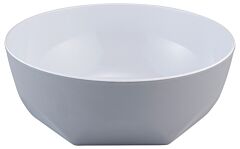
Switching from single-use packaging to reusable serveware pays for itself faster than most operators expect: a single reusable salad bowl breaks even after just 12 uses. Run the same maths on smaller items and the case gets stronger still — Dalebrook's SAN pudding pots withstand 100+ commercial wash cycles, cutting the lifetime cost per use by 70% compared with disposables. For staff restaurants, contract caterers and quick-turn lunch counters, that means every wash cycle after break-even is margin, not cost. This article sets out the numbers, explains how a closed-loop grab–go–return system works in practice, and shows which reusable food-to-go ranges — Hu, Hive, Kiru and Mayfair — fit each style of service.
The single-use problem, in numbers
Single-use packaging is expensive and generates a large amount of waste. According to government estimates cited in Dalebrook's Reusable Collection brochure, England uses 1.1 billion single-use plates every year. And the hidden costs go well beyond the bin:
- Poor food quality: cardboard and plastic takeaway boxes do not keep food warm.
- Storage pressure: single-use packaging demands large storage space back of house.
- Transport costs: disposable boxes carry a high cost due to transportation, and the deliveries never stop.
Reusables attack all three at once. They cut the cost of waste management, transportation and packaging; melamine's high thermal insulation keeps hot food hot and cold food cold; and stackable designs — with or without lids — save storage space. Once a reusable fleet is in circulation, you no longer need constant deliveries of disposable stock, which also helps reduce pollution.
The business case: break-even after 12 uses
The core figures from the Reusable Collection are simple enough to put straight into a budget proposal:
| Metric | Figure |
|---|---|
| Break-even point, reusable salad bowl vs single-use | 12 uses |
| Commercial wash cycles a SAN pudding pot withstands | 100+ |
| Lifetime cost per use vs disposable (pudding pot) | −70% |
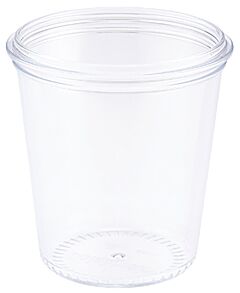
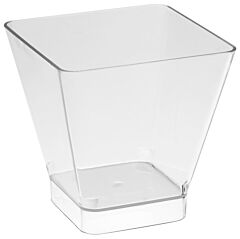
In a workplace restaurant serving the same guests daily, a salad bowl reaches 12 uses in under three weeks. Everything after that point is saving. The small pots make the point even more vividly: Dalebrook's SAN Pudding Pot (TCSN4411, 150 ml, packs of 100) and Copolyester Square Style Pot (SQ6020CP, 200 ml, packs of 200) are dishwasher safe, stackable and nestable, and their crystal-clear material supports allergen visibility and presentation. Because they survive hundreds of wash cycles, the cost of each dessert, yoghurt or fruit pot served keeps falling with every rotation.
How a closed-loop grab–go–return system works
The operating model behind these numbers is a closed loop: the dishes and pots should not leave the building. They are used, washed, stored and reused the next day. Dalebrook summarises the cycle in eight repeating stages:
- Plate up — the kitchen fills pots, bowls and bento boxes in advance.
- Transport and display — sealed, stackable meals move to the counter and stack neatly on shelf displays.
- Select and serve — guests grab and go; lidded portions keep queues short.
- Enjoy — melamine's insulation keeps the meal at temperature.
- Return — guests drop containers at a collection point; nothing leaves the site.
- Wash and reuse — everything is dishwasher safe and back in service the next day.
The brochure lists the pay-off as five compounding benefits: reduced deliveries, zero landfill waste, a circular economy, durability and space saving. Because the containers never leave the premises, there is no deposit administration with guests and no losses in the outside world — a model tailor-made for contract catering, workplace restaurants, education and healthcare sites where the audience returns every day.
Four Dalebrook ranges built for the loop
Hu — the human-centred all-rounder
Guided by three principles — Human, Hungry, Humble — Hu feels like tableware, not throwaway packaging. Developed in close cooperation with contract caterers, the melamine pots and bowls with clear SAN lids stack and nest cleanly, open and close with intuitive tabs, and offer optional venting for food quality on the move. Capacities run from a 30 ml dip pot to a 1 L bowl (T73181), with an 8–16 oz pot family (T73131–T73133) and a 700 ml bowl (T73171) covering most menus. The clever detail: the dip pot (30 or 60 ml) attaches to every Hu lid, so dressings and sauces travel with the meal — no sachets, no clingfilm.
Hive — built for quick-turn lunch counters
Inspired by nature's most efficient system, Hive is made from food-grade, germ-resistant melamine with clear reusable lids that seal meals in and keep them fresher for longer. The lid design lets multiple meals stack for shelf displays, and the whole range is lightweight, dishwasher-ready and space-saving. Capacities mirror Hu — from 30 ml dip pots up to 1 L bowls (TGY72181W) and trays — and the range is explicitly designed for Grab–Go–Return: keeping queues short, food fresher and waste minimal.
Kiru — bento-style structure for composed meals
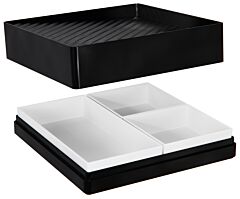
Rooted in the Japanese bento tradition, Kiru brings refined modularity to curated meals on the move. The 253 x 253 x 95 mm melamine box (black TB4105, white T4105, cream/aqua TCM4105TAQ) takes interchangeable square inserts (125 x 120 x 40 mm and 240 x 120 x 40 mm), includes space for cutlery, stacks securely and offers an open or closed vent.
Mayfair — the plate is the lid
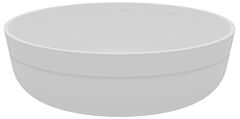
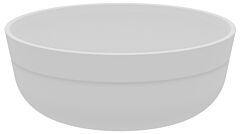
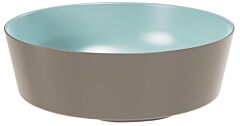
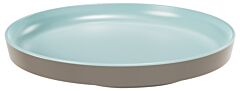
Minimal and modern, Mayfair solves transport with one elegant move: the plate doubles as a lid on the matching bowl. Three melamine sizes — 500 ml, 1.4 L and 2.4 L — in blue, sage green and yellow move seamlessly between room service, poolside dining and beyond, paired for secure transport or used individually for a refined look.
Making the switch: a practical roadmap
- Audit your disposable spend — packaging purchases, delivery frequency, storage space and waste-management costs form your baseline.
- Match ranges to service — Hive for fast lunch counters, Hu for contract-catering menus with sauces, Kiru for composed meals, Mayfair for room service and poolside.
- Start with high-rotation items — dessert and dip pots hit their break-even fastest and prove the model.
- Set up the return point and wash routine — every item is dishwasher safe; the loop only works if collection is as easy as grabbing the meal.
- Track uses against the break-even — at 12 uses per bowl, most daily operations are in profit within weeks.
Single-use packaging is a cost that renews itself with every delivery. A closed-loop serveware fleet is a cost that retires itself — after 12 uses, every service is cheaper than the last.